Email Forwarding
DocumentPro lets you automatically process documents by forwarding emails directly to a workflow-specific email address — no manual uploads required. This is especially useful for teams that receive documents like invoices, receipts, or forms via email on a regular basis.
How It Works
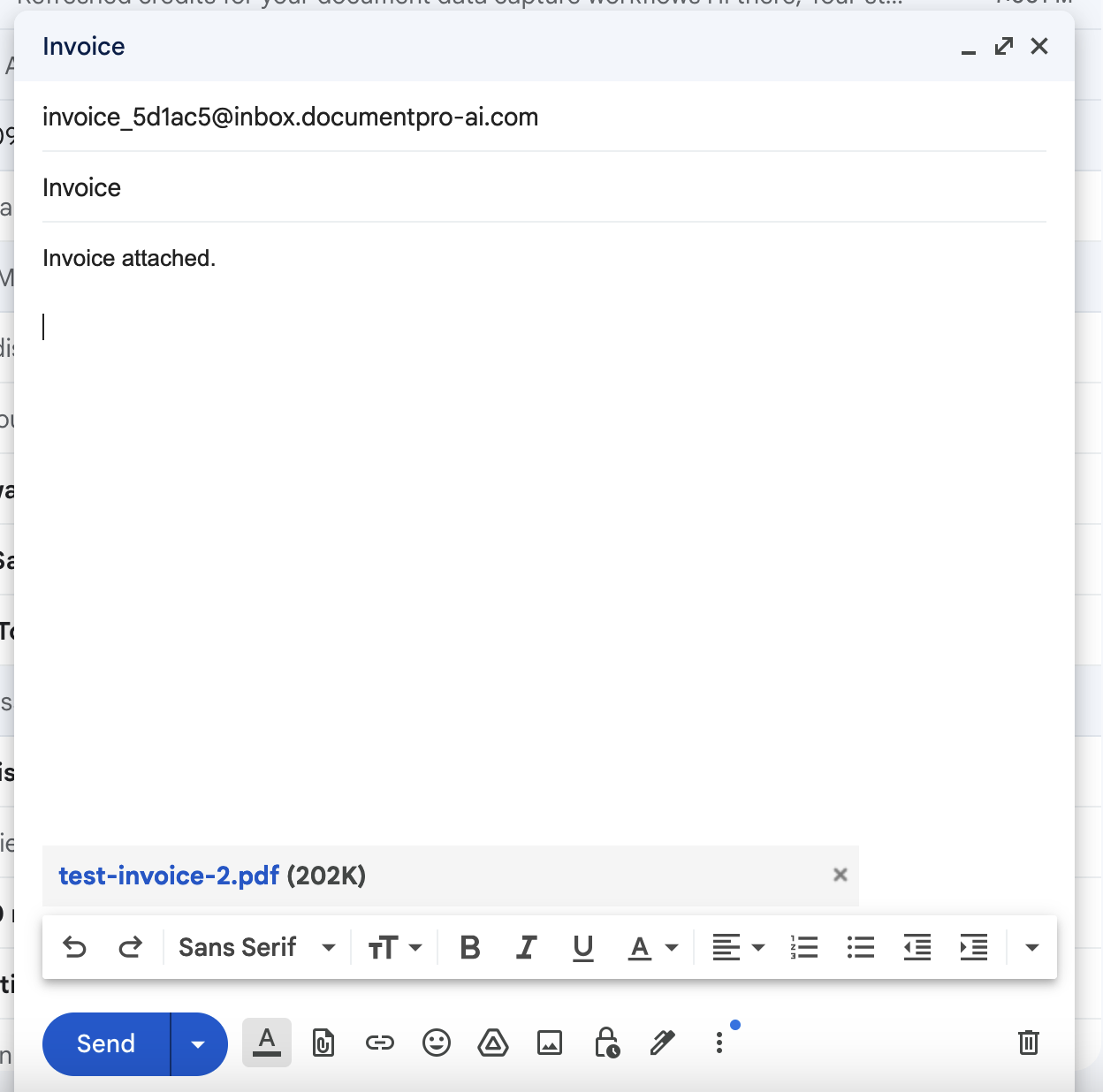
Every workflow (parser) in DocumentPro is assigned a unique email address. When an email is forwarded to that address, DocumentPro automatically processes the content:
- Email attachments are parsed by default.
- The email body can also be parsed if this option is enabled during workflow setup.
Setting Up Email Forwarding
- Create a workflow — a unique forwarding email address is automatically generated when you create a parser.
- Find your forwarding address — navigate to the Documents tab inside your parser to locate the email address.
- Configure forwarding in your email client — set up a forwarding rule or filter in your email client to send relevant emails to that address.
Using Email Forwarding
Once forwarding is configured, the process is fully automatic:
- An email arrives in your inbox with a document attachment (or relevant content in the body).
- Your email client's forwarding rule sends it to the workflow's unique email address.
- DocumentPro processes the attachment(s) and, if enabled, the email body.
- Parsed results appear in your DocumentPro workflow, ready to review or export.
Supported File Formats
The following attachment types are supported:
- JPG / JPEG
- PNG
- TIFF
If an email contains multiple supported attachments, all of them will be processed in a single submission.
Email body content (when body parsing is enabled) supports HTML and plain text formats — no additional configuration needed, as these are standard email body formats.
Routing Emails Across Multiple Workflows
If you process documents from multiple vendors or document types, you have two main approaches:
Option A: One Workflow per Document Type
Create a separate workflow for each vendor or document schema, then use email forwarding rules to route emails to the right address based on the sender's domain or address.
Most email clients support sender-based forwarding rules:
- Gmail — use Filters to match sender and auto-forward to the workflow address
- Outlook — use Rules to route by sender domain or address
- Automation tools (e.g., Zapier, Make) — useful for more complex routing logic
Best for: Teams with vendors whose invoice formats differ significantly, or where you need separate output schemas per document type.
Option B: One Consolidated Workflow
Design a single workflow schema that captures the common fields across all your document types, and forward all emails to that one address.
Best for: Teams where documents share a similar structure across vendors (e.g., standard invoice fields like vendor name, line items, total, PO number), and where simplicity is the priority.
Tip: Start with a consolidated workflow to get up and running quickly. Add vendor-specific workflows later only if you find extraction quality needs improvement for certain document types.
Email Body Parsing
By default, DocumentPro processes attachments only. If you also want to parse the content of the email body itself, this option must be enabled at the time of workflow creation — either through the web interface or via the API.
Important Notes
| Topic | Detail |
|---|---|
| Multiple attachments | All supported attachments in a single email are processed together. |
| Email body parsing | Must be enabled during workflow creation; cannot be toggled after the fact. |
| Subject lines | The email subject can be used to help identify the document within DocumentPro. |
Troubleshooting
If forwarded documents aren't appearing in DocumentPro, check the following:
- Wrong email address — confirm you're using the forwarding address from the correct workflow's Documents tab.
- Unsupported file format — verify the attachment is PDF, JPG, PNG, or TIFF.
- Account limits — check whether you've reached your account's storage or processing limits.
Security Considerations
- Each workflow's email address is unique and private — avoid sharing it publicly or including it in shared documents.
- If your organization's security policies require it, encrypt sensitive documents before forwarding.
Best Practices
- Use descriptive subject lines when forwarding — they help you identify documents inside DocumentPro.
- Create a dedicated folder or label in your email client for documents you plan to forward. This makes it easy to track what's been sent and quickly re-forward anything that needs reprocessing.
- Verify processing after setup — after configuring forwarding for the first time, send a test email and confirm the parsed results appear correctly in your workflow before going live.